Page 77 of 119

Cholesterol my ass!

By the mid 1950?s, CVD became our number one killer and remains the leading killer today. It was around this time that the lipid hypothesis started to gain popularity. The lipid hypothesis, which was proposed by Ancel Keys in the late 1950?s, is a theory claiming there is a direct relationship between the amount of saturated fat and cholesterol in the diet and the incidence of CVD. This theory however, is simplistic and unfounded; the biggest health scam in American history.

Today in the United States one person will die from CVD every 37 seconds.6 This year in the U.S. an estimated 1.26 million people will have a new or recurrent heart attack, and just short of half will die.7 Approximately 80,000,000 people or more than 25% of The U.S. population has one or more forms of cardiovascular disease.7 In 2002 CVD mortality was nearly 60% of ?total mortality? in the U.S.6 This means that out of 2.4 million deaths from all causes, CVD was listed as a primary cause on about 1.4 million death certificates. CVD causes more deaths than the next 7 causes combined. It?s safe to say CVD had a meteoric rise from the 1930?s to the 1950?s to become number one and to this day the incidence is still rising. (We’re a Fat Unhealthy Nation. part I)

Did you know…

…cholesterol is a substance vital to the health of all cells in your body?

…your body produces 3 to 4 times more cholesterol than you eat?

…when you decrease your consumption the body increases it’s production and visa-versa?

…despite the same amounts of cholesterol flowing through them, veins never become sclerotic?

…arteries that pass through the bony channels of the skull and the few branches that pass through heart muscle never become sclerotic?

…studies of the hearts of people who have died from heart attacks showed approximately 1/5th of the victims had no evidence of coronary atherosclerosis?

…oxidized cholesterol is what accumulates in vessels not normal cholesterol?

…3/4’s of the lipids found in plaque is polyunsaturated?

…in Japan more people die of cerebral hemorrhage than in most other countries, and is greatest in those with the lowest cholesterol levels.

…there is no correlation between saturated fat consumption and cardiovascular disease? In fact, many societies have decreased their animal fat consumption with a corresponding increase in cardiovascular disease.

…there are countless scientific and observable contradictions to the Lipid Hypothesis? Only one scientific contradiction is needed to disprove a hypothesis.

Do your homework and judge for yourself.

A bacteria deficiency?

Whether you know it or not the body needs certain types of bacteria in order to maintain optimum health. Within our digestive tracks live all types of bacteria. There is a constant battle being waged in our intestines between “good” and “bad” bacteria. The “good” bacteria are called probiotics and fight bad bacteria like E. coli and other pathogenic types.

When our probiotics start to loose the battle in our intestines, one can develop a disorder called dysbiosis. This disorder has been linked to a number of problems including; indigestion, bloating, IBS irritable bowel syndrome, gas, diarrhea, lactose intolerance, bladder infections, skin rashes, colon and breast cancer. Is a probiotic deficiency common? The answer, yes. Many factors can cause a deficiency including; stress, antibiotics, poor diet, infections and aging. Many experts feel without supplementation it’s hard for the average person to have a sufficient amount of probiotics.

When probiotics are winning the battle they perform a number of functions. They are essential in the proper digestion and absorption of food. They keep our immune systems functioning properly – prevent food allergies – repair and maintain the GI tract lining – and suppress “bad” bacteria.

I have found the best product out there to be Theralac. Take 2 capsules per day for the first 2 weeks and once the GI tract has been colonized you can reduce the dose to 2 caps per week.A

Barbell Workout for Hard Gainers

If you only have access to a barbell, try these workouts from MensFitness.com:

Workout I

1 Front Squat
Sets: 5 Reps: 5 Rest: 90 sec.
Start with the barbell on the supports of a power rack at about shoulder height. Grab the bar overhand and raise your elbows until your upper arms are parallel to the floor. Now lift the bar off the rack, letting it roll toward your fingers-this is where it should rest throughout the exercise (as long as you keep your elbows raised, you won’t have trouble balancing the bar) [1]. Squat as low as you can [2], and then drive with your legs to return to the starting position. That’s one rep.

2 Snatch
Sets: 5 Reps: 5 Rest: 90 sec.
Place a barbell on the floor and grab it with an overhand grip, hands twice shoulder-width apart. Keeping your lower back in its natural arch, crouch down behind it as if you were going to perform a deadlift [1]. Now explosively stand up and raise the bar straight up in front of your torso. When the bar reaches chest level, flip your wrists to face the ceiling and allow the momentum to help you press the bar straight overhead [2]. Reverse the motion to return the bar to the floor. That’s one rep.

3 Barbell Shoulder Press
Sets: 5 Reps: 5 Rest: 90 sec.
Stand with your feet shoulder-width apart or slightly narrower and grab the bar with a slightly wider-than-shoulder- width grip (wrap your thumbs around the bar). To get the bar into position, you can either explosively heave it up off the floor and up to your shoulders, or set the bar at shoulder level on the supports of a power rack. If the bar is on the rack, nudge it off and let it rest against the front of your shoulders. Squeeze your shoulder blades together, and push your chest out [1]. Begin pressing the bar overhead, retracting your head as the bar rises to keep it out of the way. When the bar passes your head, press it up and slightly backward so that it ends up in line with the back of your head [2]. Hold for a moment, then lower the bar back to your shoulders. That’s one rep.

Check out the other workout by clicking here.

If you?re a hard gainer, these workouts can be beneficial because they?re all compound movements that incorporate more muscle groups.

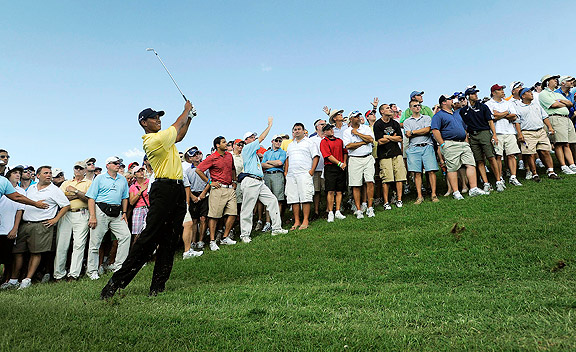
Improve your golf game with these exercises

The New York Sports Clubs shares some tips to get your body in golf shape for when you attack the links this summer.

Big Bertha ? Driving power from your legs and arms will increase your yards. Grab your driving club and get started:

Stand with feet a little wider than shoulder width. Bending at the hips and knees, lower into a squat and hold the position. Hold the club with both hands in front of you, parallel to the floor. While holding the squat, bend the elbows bringing the club to the chest at an angle, press out and repeat with the angle in the other direction. Continue pressing in and out at a diagonal for 30 times, working your way up to 75.

Caddy Shack ? For stamina to walk the course, follow this move to get your heart rate up and cardiovascular system conditioned:

Place three tees on the floor about two feet from each other in a line. Starting on the left of the first one, hop over each with a dbl hop between them. When you get to the end, hop back to the starting position. Try to continue hopping for 30 seconds, working your way up to a minute.

Hole in One ? Core strength is imperative to drive the ball down the green. Try this core strengthener to get that hole in one:

Sitting on the floor with your feet flat on the ground, grab a golf ball in your right hand. Lean back slightly, lifting your feet off the floor a few inches holding yourself stable by contracting your stomach muscles. Holding that position, gently lower right leg as you slightly lift the left and pass the ball through the legs to the left hand. Switch the legs and pass the ball back to the right hand, through the legs. Continue for 20-30 repetitions.

Back Nine ? With all the swinging and bending, a golfers low back is a must to strengthen

Lie on your stomach, legs out straight and arms straight at your side. Lift up your head and legs at the same time, keeping your spine in line with your head. Hold the position with your low back and glutes for 3-5 seconds and release. Start with 8-10 working your way up to 15.

Club House ? When your game is over, before hitting the showers or clubhouse, make sure to stretch

On all fours, round your back so you feel your spine open, lifting up your belly button to the ceiling, tucking your glutes and head under. Hold for 3 seconds. Reverse the move by lifting your head to the ceiling and curving your back under, tail bone to the ceiling.

There you have it. If your game still stinks, then it might be time to pick up another hobby!

Antibacterial Soap

Washing your hands is the number one way to prevent the spread of infectious illness. This is especially critical after using the toilet, changing the baby, handling raw foods, working at your desk, or shaking hands. But, are antibacterial soaps better for this than other soaps.

Researchers at U-M’s School of Public Health reviewed 27 studies that examined the effectiveness and safety of antibacterial soaps containing triclosan. Detergents that used the word “antibacterial” on their labels were also included in the studies. Alcohol-based hand gels were excluded.

According to researchers at the University of Michigan, Antibacterial soaps aren’t any better than ordinary soaps for washing away germs. They also warn that antibacterial soaps may have the unwanted side effect of promoting antibiotic resistance in users.

?

« Older posts Newer posts »