Category: Workout programs (Page 3 of 12)

Exercise induced hormone changes do not promote muscular gains

Exercise induced endogenous hormone levels have been studied extensively. Researchers have examined how the different components of training including sets, repetitions, load and rest intervals affect serum levels of hormones such as testosterone, growth hormone and cortisol. Many studies have demonstrated there is an acute increase in serum levels of anabolic hormones after intense resistance exercise.

To be more specific, high intensity exercise coupled with short rest intervals that is performed with large muscle groups are associated with large rises in these hormones when compared to other training methods. Conversely, training small muscle groups like the biceps has been shown to have no effect on serum hormone levels. Because of the findings in many studies, training programs have been constructed to maximize the post-exercise rise in these hormones based on the assertion that exercise-induced increases in hormones like testosterone and GH will enhance muscle size and strength. But, considering the fact that these increases in hormone levels are very small and of short duration, will they produce muscular gains.

A study from the Kinesiology Dept. of McMaster University in Canada found that exercise induced hormone levels had no effect on muscle size or strength after 15 weeks of resistance training.

There is evidence that a minimal basal level of testosterone is required to support strength and hypertrophy gains, which are otherwise attenuated. Therefore, the hormone-sensitive processes that underpin muscle anabolism at hypo- and supra-physiological hormone levels are not being activated appreciably by exercise-induced increases in hormone availability or at least do not result in any measurable enhancement of strength or hypertrophy.

(J Appl Physiol 108(1); 2010)

The “After Burn” may not be a myth

We’ve all heard about the “After Burn” effect of exercise.

That coveted condition where the body continues to burn calories long after we’ve finished working out.

Well, it seems that science may have proven that this does indeed happen and at a higher and more intense rate than expected.

Studies which are done properly (many are not), find that extra calories are burned in the hours after exercise — but only if subjects exercise hard and long; intensely for 45 minutes.

And if they exercise even harder, they burn even more calories afterward.

Everyone ‘s favorite new work out

The economy has affected everyone’s life in every aspect including working out.

Trends depend on many factors, said the survey’s lead author, Walt Thompson. Take Pilates, which dropped off the survey’s list from No. 9 last year. Thompson believes the economy made Pilates equipment and specialized instructors too expensive for clubs to maintain. He’s not sure if Pilates will make a return to the top 20, but he doesn’t expect a few of this year’s trends to stick around long.

CrossFit: The training, the games, the BS

What is CrossFit (CF)? In a nut shell it’s performing movements and or exercises under time that are continuously varied from workout to workout. Started in the mid 1990’s, this training system does have value in improving ones fitness level, but the claims made on the CrossFit website are unsubstantiated and untenable.

CF’s upside according to its proponents is being a total-body conditioning workout that is purposefully varied, which inhibits boredom. I think it’s a home run for fitness enthusiasts because the workouts are challenging and competitive. CF’s inherent difficulty, notice I said difficulty not intensity, also benefits the average person because most people do not train hard enough to elicit any measurable result.

Read more: CrossFit

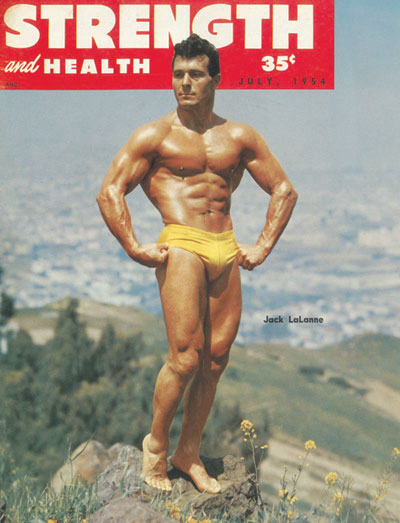
Jack LaLanne dies at 96

Jack LaLanne, (September 26, 1914 – January 23, 2011) was an American fitness, exercise, and nutritional Icon and motivational speaker who many referred to as “the godfather of fitness” and the “first fitness guru.”

“The crusade is never off my mind — the exercise I do, the food I eat, the thought I think — all this and how I can help make my profession better-respected. To me, this one thing — physical culture and nutrition — is the salvation of America.”

“Well it is. It is a religion with me,” he told What Is Enlightenment, a magazine dedicated to awareness, in 1999. “It’s a way of life. A religion is a way of life, isn’t it?”

(Jack LaLanne’s accomplishments as reported by his website)

* 1954 (age 40): swam the entire length (8,981 ft/1.7 mi) of the Golden Gate Bridge in San Francisco, under water, with 140 pounds (64 kg; 10 st) of equipment strapped to his body; a world record.
* 1955 (age 41): swam from Alcatraz Island to Fisherman’s Wharf in San Francisco while handcuffed. When interviewed afterwards he was quoted as saying that the worst thing about the ordeal was being handcuffed, which significantly reduced his chance to do a jumping jack.
* 1956 (age 42): set a world record of 1,033 push-ups in 23 minutes on You Asked For It,[22] a television program hosted by Art Baker.
* 1957 (age 43): swam the Golden Gate channel while towing a 2,500-pound (1,100 kg; 180 st) cabin cruiser. The swift ocean currents turned this one-mile (1.6 km) swim into a swimming distance of 6.5 miles (10.5 km).
* 1958 (age 44): maneuvered a paddleboard nonstop from Farallon Islands to the San Francisco shore. The 30-mile (48 km) trip took 9.5 hours.
* 1959 (age 45): did 1,000 star jumps and 1,000 chin-ups in 1 hour, 22 minutes and The Jack LaLanne Show went nationwide.
* 1974 (age 60): For the second time, he swam from Alcatraz Island to Fisherman’s Wharf. Again, he was handcuffed, but this time he was also shackled and towed a 1,000-pound (450 kg; 71 st) boat.
* 1975 (age 61): Repeating his performance of 21 years earlier, he again swam the entire length of the Golden Gate Bridge, underwater and handcuffed, but this time he was shackled and towed a 1,000-pound (450 kg; 71 st) boat.
* 1976 (age 62): To commemorate the “Spirit of ’76”, United States Bicentennial, he swam one mile (1.6 km) in Long Beach Harbor. He was handcuffed and shackled, and he towed 13 boats (representing the 13 original colonies) containing 76 people.[23]
* 1979 (age 65): towed 65 boats in Lake Ashinoko, near Tokyo, Japan. He was handcuffed and shackled, and the boats were filled with 6,500 pounds (2,900 kg; 460 st) of Louisiana Pacific wood pulp.[24]
* 1980 (age 66): towed 10 boats in North Miami, Florida. The boats carried 77 people, and he towed them for over one mile (1.6 km) in less than one hour.
* 1984 (age 70): handcuffed, shackled, and fighting strong winds and currents, towed 70 rowboats, one with several guests, from the Queen’s Way Bridge in the Long Beach Harbor to the Queen Mary, 1 mile.[25]

« Older posts Newer posts »