Category: Power lifting (Page 3 of 9)

Partial reps vs full range of motion

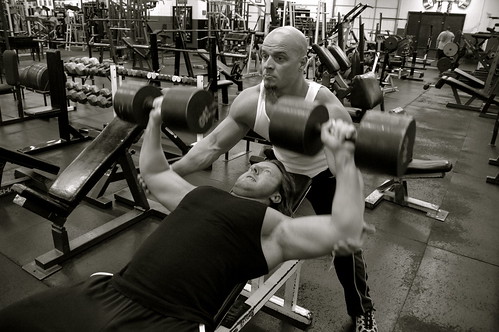
I am not a huge fan of using partial reps, but will use them sparingly with experienced lifters to “through a wrench into their workout”. When I prescribe them they are performed after the client has already reached momentary concentric failure during a set. But, because partial reps place such high demands on the recovery ability of the muscles being worked, I caution against using them more than once every 4 workouts per body part. In reference to this belief, I received an email from an intermediate lifter claiming a study (J Strength Cond Res, 2004, 18(3), 518-521) proved partial reps should be incorporated in his workout instead of full range reps.?

I did a little research, as always, and found the study the gentleman was referencing. This study was conducted over a 10-week period using the bench press as the criterion measurement. Subjects were divided into three groups. Group one trained with full range of motion sets. Group two trained with partial range of motion sets. A partial range of motion was defined as two to five inches from full extension of the elbows. Group three trained with a combination of both partial and full range reps. All groups were pre and post-tested with a full range of motion one rep maximum. No differences were found between the groups. So should we or shouldn’t we use partial reps?

There are several problems I find with this study that are common to many studies trying to illuminate the most efficacious training principles. First, and perhaps most important, inexperienced, recreational subjects were used. Inexperienced subjects can achieve gains in the first few months on just about any program. Second, the length of time the study was conducted was entirely too short. six, eight or, like this study, 10 weeks is just not enough time to show the efficacy of a particular training protocol. And third, the intensity of the exercises or perceived exertion is not mentioned or monitored. Are the subjects going to failure on their sets? Are some subjects pushing themselves harder than others? Are the subjects training in the same manner on exercises other than the bench press? This study like most training studies shows nothing.

Fitness Myths Busted

Is performing cardio the best way to lose fat?
There are 3 things to keep in mind about cardio when trying to get leaner. One is that it doesn?t build muscle. Two, it doesn?t preserve muscle while losing weight. Both are extremely important if your goal is not only to get leaner, but to stay that way. As we lose weight the body does not discriminate where the weight comes from. We lose muscle along with fat, especially on a low calorie diet. And performing cardio accentuates this phenomenon.

Lastly, unless you enjoy cardiovascular training, it?s just not worth the time. The work to benefit ratio is dismal to say the least. Unless you?re willing to bust your butt and perform 60 ? 90 minutes of cardio a day, which will hinder your muscle building capacity, cardio is not worth it.

Will training your abs using the right exercise our equipment give you washboard abs?

Is reducing your calories the best way to lose weight?

If I’m not sore a couple of days after a workout, did I not train hard enough?

Get the answers to these and other common fitness myths in my Fitness Myths Busters article.

Squat and dead lift vs stability ball exercises for core activation

Unstable Surface Training (UST) has moved from being used almost exclusively in rehabilitation to becoming common place among personal trainers and strength coaches. One can’t go to a gym and not see somebody training on a Bosu ball, stability ball, wobble board or foam pad. It’s so popular entire books have been written on this type of training. But do not be fooled by its popularity.

UST is not popular because it works, but because of a tremendous media campaign. The fitness industry is always looking for something new. They know here’s huge money in marketing a piece of equipment and/or workout program.

Performing exercises on unstable equipment can be challenging no doubt, but research has not shown that the type of balance, and core stability developed through UST will transfer to any sports skill. Performing exercises on unstable equipment will make an individual proficient at performing resistance exercises on unstable surfaces but will not improve sports performance. Is UST training even necessary?

Researchers from Appalachian State University compared trunk muscle activity during stability ball and free weight exercises. The stability ball exercises utilized were the quadruped, pelvic thrust and ball back extensions. The free weight exercises were the squat (SQ) and deadlift (DL). During all exercises muscle activity was collected using electromyography (EMG).

During the study trunk muscle activity during SQ and DL’s was equal to or greater than which was produced during stability ball exercises. This was true even when 50% of the 1 rep max was used during SQ and DL. The role of UST is again shown to be in question.
(Journal of Strength Conditioning Research 22:95-101,2008)

Sex differences in the gym

Weight training can elicit numerous benefits including injury prevention. However, weight lifting has it’s share of injuries and according to a study in Cincinnati Ohio, which examined a sample of 3713 patients, these injuries vary between genders. The objective of this study was to examine the differences in injuries associated with strength training in adolescents and young adults.

Comparisons of accidental injuries between the sexes revealed that women had significantly greater odds while strength training when compared to men. Women had higher foot, trunk, and leg injuries, where as men had higher arm, hand, and head injuries. Men had a much higher percentage of their injuries in the form of strains and sprains compared to women, but there was no difference in reported fractures. The trunk was by far the most commonly injured body part for both men (36.9%) and women (27.4%).

The findings of this study show that men are at far greater risk for exertional types of weight training injuries than women. However, women had significantly higher odds of accidental weight training injuries compared to men, which researchers say is of particular concern. Common accidental injuries include dropped weights, improper use of equipment, or tipping over of equipment. Does this really surprise anyone?

Best exercise for building big lats

Over the years it has been well established that performing exercises behind the neck, like lat pull downs, is detrimental to the shoulder joint. The unnatural movement pattern of bringing the bar behind ones head causes external rotation combined with horizontal abduction, which places the shoulder at a great risk of injury. However, when the lat pull down is performed to the front of the head, there is a lower stress on the shoulder joint because of a higher degree of stabilization by the rotator cuff muscles.

Not only is the front of the neck lat pull down (FNL) a safer exercise, but it allows for a great range of motion. Despite the amount of empirical and anecdotal evidence illuminating the possible negative effects of behind the neck pull downs (BNL), proponents tout is greater efficacy for building bigger lats. But Is there a difference in the activity of the primary movers during different lat pull down exercises?

A recent study analyzed the electromyographical (EMG) activity of 3 different lat exercises. The exercises used where the BNL, FNL, and V-bar behind the neck lat pull (V-bar). Twenty four experienced weight lifters participated in the study performing 5 reps with each exercise, with electrodes positioned over 4 muscle bellies (pectoralis major, latissimus dorsi, posterior deltoid, and biceps brichii). Although a previous study (J Strength Cond Res 16:539-546) showed a greater activity of the latissimus dorsi muscle using FNL when compared to the BNL, this was not the case with the present study. (J Strength Cond Res 2009:23(7);2054-2060)

If your objective is to build bigger lats, than any of the 3 exercises in this study can be used with equal activation. However, with no advantage being found in this or any other study to date performing the BNL, one should question it’s use. There is no movement in sport or daily activity that the BNL mimics. Conversely, the FNL mimics movement patters in sports and daily activities helping to reduce injury and improve function.

There are a few concerns I have with this and previous studies analyzing prime mover activation in lat exercises. The distance between the hands, which were the same for this and other studies, has a huge impact on the range of motion, the load used, and EMG activation. The closer the grip one uses performing a lat pull down, the greater the range of motion and load, which consequently yields a greater activation of the prime movers.

Changing exercises alters movement patterns and muscle recruitment, which can increase or decrease the load used. A greater load, which elicits a greater EMG activation, can always be achieved with movements to the front of the neck as opposed to the back of the neck. For this reason, using the same load for all 3 exercises doesn’t show the true ability of an exercise to activate target muscles. The correct load used would be such that each exercise was performed with maximum intensity. Only then can there be an apples to apples comparison.

« Older posts Newer posts »