Category: Sports Health and Fitness (Page 4 of 8)

The Skinny Guy Workout

If you?re a hard gainer, you?ve likely tried all kinds of workouts trying to add size to your frame. But as Men?s Fitness.com points out, your problem probably lies somewhere in between working out too much and not eating enough.

MF.com highlights three exercises to do for all hard gainers, as well as some dieting tips to help pack on the muscle.

WORKOUT
Perform these exercises three days per week, resting at least a day between sessions. Vary the sets and reps, too. On Day 1, complete five sets of five reps for each lift, resting two minutes between sets. On Day 3, do four sets of 10, resting 90 seconds. On Day 5, do three sets of 15 reps with 60?90 seconds’ rest in between.

1.Squat
Set up a barbell on the supports of a squat rack. Step underneath the bar, squeeze your shoulder blades together, and let the bar touch your upper traps. Grab the bar with your hands as close together as is comfortable. Nudge the bar off the rack, take three steps backward, and stand with your feet a bit wider than shoulder-width apart and toes turned slightly outward [1]. Take a deep breath and bend your hips back as far as you can, keeping the arch in your lower back. Then bend your knees and lower your body as far as you can (try to squat to where your thighs are at least parallel to the floor) [2]. Explode back upward to the starting position. That’s one rep.

2. Clean and Press
Set a barbell on the floor, crouch down, and grab it with hands shoulder-width apart. Your lower back should be in its natural arch [1]. Explosively stand up and shrug the bar, coming up onto the balls of your feet. As the bar rises to chest level, flip your wrists over so that your palms face the ceiling and your upper arms are in the bottom position of a shoulder press [2]. From here, press the bar straight overhead [3]. Reverse the motion to return the weight to the floor. That’s one rep. If you feel your back is rounding when you pull the weight off the floor, perform the exercise by starting with the bar at just above knee height, and “muscle” the weight up from there.

3. Pullup
Grab a pullup bar with an overhand grip, hands outside shoulder width. Allow your body to hang [1]. Pull yourself up until your chin is over the bar [2], and then lower yourself back to the starting position. That’s one rep. Depending on how many reps you need to do, you can add weight using a belt or holding a dumbbell between your feet (you may need to do this on the five sets of five day). You can also use an elastic exercise band to help you perform more reps (such as on the 10- and 15-rep workout days). You can get a jump stretch band that works great for this at elitefts.com.

Check out MF.com?s tips for eating for more muscle.

Waiting until summer to improve your golf game is too late.

The mechanics of a golf swing can cause a variety of injuries. The most common area golfers experience injuries is the lower back. Other areas golfers complain about are the shoulder, or more specifically the rotator cuff, the left elbow, and the left wrist (for right handers). Unfortunately, there is little data available about the seriousness of injuries as a result of playing golf or how to reduce them. However, if we apply what we know from other sports through research and empirical data, I have seen many golfers not only decrease their risk of injury but improve their game.

What golfer in their right mind wouldn?t want to improve his game? As a matter of fact, golfers, more than participants in any other sport, are fanatical. There are more than 20 million golfers in the US and most of them are obsessed with their abilities on the course. They will drop $700 on an iron and $400 for a driver. Many will pay thousands of dollars to belong to prestigious country clubs. Many more will spend hundreds of dollars during the golf season on balls that they?re eventually going to lose. But the average golfer won?t spend a dime on improving his biggest asset to his game: his body. I cannot imagine owning a $2,000 set of clubs and not doing anything to ensure I could use them to their fullest capacity.

To be successful at golf, you need functional strength, flexibility, endurance (ability to hit the club well, over and over), coordination, finesse and timing. You can?t find these aspects of the game in a pro shop. I don?t care how much you paid for your Big Bertha Fusion Irons or your balls that claim to go 20 to 40 yards farther than ordinary balls; if you lack the above, you?re going to be another frustrated player.

Golf: Reducing your isk of injury and improving your game.

Did you know?

Bullz-Eye.com Fitness Editor Mike Furci answers readers questions about water, U.S. hospitals and myths about salt.

…it?s not necessary to drink eight 8-ounce glasses of water a day to maintain optimum health? We?ve been told this arbitrary recommendation for years. There is little evidence for or against any of the supposed benefits of extra water, such as increased toxin excretion, improved skin tone, lessened hunger, and reduced headache frequency. A review of the available research concludes that for average healthy people, more water doesn?t mean better health. (Mercola.com newsletter)

To read the rest of the Q&A, click here.

Treating Injuries with Blood?

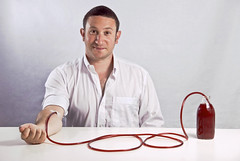
Platelet rich plasma therapy (PRP) involves injecting platelets, which release proteins and other partices involved in your own body?s self healing process, near the injured area. According to the New York Times online, Hines Ward and Troy Polamalu used their own blood in this innovative treatment before winning the Super Bowl. Other professional and recreational athletes have used PRP as well.

Dr. Mishra said that he was particularly encouraged by PRP therapy?s effectiveness on chronic elbow tendinitis, or tennis elbow. For a 2006 study published by The American Journal of Sports Medicine, he used the treatment on 15 of 20 patients who were considering surgery; the five others received only anesthetic. Two months later, the patients receiving PRP therapy noted a 60 percent improvement in pain measurements, compared with 16 percent for the control group.

?It?s a better option for problems that don?t have a great solution ? it?s nonsurgical and uses the body?s own cells to help it heal,? said Dr. Allan Mishra, an assistant professor of orthopedics at Stanford University Medical Center and one of the primary researchers in the field. ?I think it?s fair to say that platelet-rich plasma has the potential to revolutionize not just sports medicine but all of orthopedics. It needs a lot more study, but we are obligated to pursue this.?

Dr. Neal ElAttrache, the Los Angeles Dodgers? team physician, used platelet-rich plasma therapy in July on a partially torn ulnar collateral ligament in the throwing elbow of pitcher Takashi Saito. Surgery would have ended Mr. Saito?s season and shelved him for about 10 to 14 months; he instead returned to pitch in the September pennant race without pain.

NFL Combine not a predictor of performance.

Every year the NFL invites about 3% of approximately 10,000 college football players to participate in a series of tests called a combine. A combine is designed to assess the skills of promising college football players. These athletes give it their all in hopes of getting drafted and consequently being offered a contract. Although the tests used during the 5 days of the combine require skill and athleticism, its predictive value is in question.

The NFL uses the combine as a key element of the player-selection process. A recent study calls into question the validity of most of the exercises and suggests a significant amount of money is wasted. Researchers found combine skills clearly lack any meaningful predictive value of player performance, except for running backs and sprint times. One explanation the researchers give is the popularity of combine prep courses. Other than marketing claims, there is no research that shows any course improves combine performance. If they do, however, these programs could dilute performance differences. Unfortunately for the players being tested, and team owners who write the checks, these improvements in combine skills do not transfer to athletic ability on the field.
(Journal of Strength & conditioning Research 2008;22(6))

« Older posts Newer posts »