Tag: weight training workouts (Page 3 of 5)

The Good Morning

Bending over to pick something up can be a very dangerous move if done with a rounded back. Most people in their lifetime will have an injury to the lower back. One way to help prevent such injuries is to do the good morning.

Performing the good morning is an excellent choice for strengthening and building the posterior chain, which includes the lower back, glutes and hamstrings. The glutes (butt) and the hamstrings are responsible for hip extension while the muscles of the lower back (erector spinea) are contracted statically.

Because of the large degree of hip flexion, the gluteus maximus and the hamstrings are utilized throughout the movement. The glutes work in unison with the hamstring to extend the hips in the concentric (raising) part of the movement. The hamstrings, located on the back of the upper thigh, become more involved as you begin to decrease the degree of hip flexion while raising the weight. The erector spinea, which run the length of your spine on both sides, are statically contracted throughout most of the movement, keeping the normal curvature of the spine. A static contraction of the rhomboids and the trapezius muscles help maintain the shoulders.

Extension of the body occurs when the upper body, torso and pelvis rotate up and back. The biggest mistake I see with this movement is allowing the back to ?round? and magnifying the kyphotic (upper back) curvature while de-emphasizing the lordotic (lower back) curvature. I need to add that a slight curve of the upper back will present no danger and will happen to most while using heavy weight, but if you look like a big question mark (?) while performing the exercise, that?s a different story.

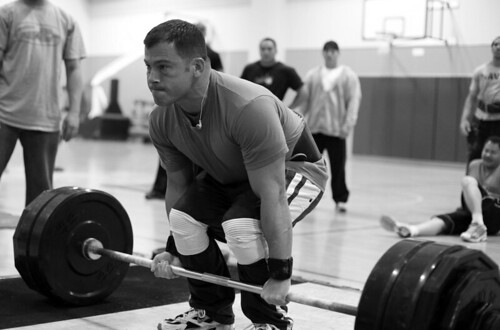
The good morning

Partial reps vs full range of motion

I am not a huge fan of using partial reps, but will use them sparingly with experienced lifters to “through a wrench into their workout”. When I prescribe them they are performed after the client has already reached momentary concentric failure during a set. But, because partial reps place such high demands on the recovery ability of the muscles being worked, I caution against using them more than once every 4 workouts per body part. In reference to this belief, I received an email from an intermediate lifter claiming a study (J Strength Cond Res, 2004, 18(3), 518-521) proved partial reps should be incorporated in his workout instead of full range reps.?

I did a little research, as always, and found the study the gentleman was referencing. This study was conducted over a 10-week period using the bench press as the criterion measurement. Subjects were divided into three groups. Group one trained with full range of motion sets. Group two trained with partial range of motion sets. A partial range of motion was defined as two to five inches from full extension of the elbows. Group three trained with a combination of both partial and full range reps. All groups were pre and post-tested with a full range of motion one rep maximum. No differences were found between the groups. So should we or shouldn’t we use partial reps?

There are several problems I find with this study that are common to many studies trying to illuminate the most efficacious training principles. First, and perhaps most important, inexperienced, recreational subjects were used. Inexperienced subjects can achieve gains in the first few months on just about any program. Second, the length of time the study was conducted was entirely too short. six, eight or, like this study, 10 weeks is just not enough time to show the efficacy of a particular training protocol. And third, the intensity of the exercises or perceived exertion is not mentioned or monitored. Are the subjects going to failure on their sets? Are some subjects pushing themselves harder than others? Are the subjects training in the same manner on exercises other than the bench press? This study like most training studies shows nothing.

Perfect Pecs

Like a great set of developed arms, a well developed chest always gets attention.? Chest and arms are the most frequently worked body parts in any gym across the country.? You never hear of anyone skipping a chest workout to do legs, but frequently hear people skipping their leg workout.? Most of this is due to shear laziness, but some is because chest is much more fun to work.

In their quest for an “Arnold like” chest many people look for that one exercise or that one workout that, like magic, will give them the chest they want.? Unfortunately, genetics, as with all body parts, determines the size and shape of ones chest.? This doesn’t mean, however, that one can’t improve upon what they have.

Do not get caught up in the game of trying to make your muscles look a certain way.? You will consistently be disappointed.? Instead concentrate on making the best of what you’ve got.? You can do this by hitting the chest from a variety of angles.? It is also imperative you “feel” the muscle being worked.? Concentrating on feeling your chest work is as important as performing the exercises. And last, using TEMPO to increase muscle tension is essential and will help to improve your concentration level.?

Learn more about these and other guidelines to build Perfect Pecs.

KISS for improving soccer performance

These days it?s becoming common practice to start sports earlier and earlier in a child?s life. Soccer is no exception. In the United States the popularity of soccer has exploded along with strength and conditioning camps focusing on sport specific programs. Unfortunately many coaches do not train their players correctly because they do not look at the metabolic demands of the sport.

Research on soccer players has shown, to the surprise of many, anaerobic as well as aerobic power are prerequisites to success. More-over, it?s been reported that 96% of the sprints in a soccer game are shorter than 30m, and 49% are shorter than 10m. It?s becomes obvious that strength and power are important aspects of a player?s development. As soccer becomes more competitive, becoming faster and stronger to get to the ball before your opponent by jumping or sprinting is becoming more important. As a strength coach the question is, how do we develop a player to their optimum ability?

A study by Chelly et al recently reported the effects of a back squat training program on leg power, jump performance, and field performance in junior soccer players. Twenty two male soccer players were divided into two groups a resistance training group (RTG) and a control group (CG). Both groups completed tests before the start of the program and after 2 months of strength training twice per week with heavy loads (80 ? 100% 1RM). The tests included a force velocity test to evaluate power, 3 jump tests, a 40m dash, and a 1 RM back half squat. (J Strength Cond Res 2009;23(8):2241-2249)

No significant changes were noted in leg or thigh muscle volume after the 2 month training period between the 2 groups. However, the RTG showed significant improvement over the CG in leg cycling power, jumping and sprinting. This is another example of the value in sticking to the basics. Too many coaches try to reinvent the wheel while training their athletes. There is no need or value in complicated, high volume strength training programs. KISS, Keep It Simple Stupid and train according to the athletes needs

Partial reps are equal to full range of motion reps.

Most experts have long held that partial repetitions provide no benefit to the serious weightlifter. This was not the finding of a study done at the University of Southern Mississippi compared using partial range of motion (ROM) repetitions and full ROM repetitions in the development of strength in untrained males. As far as the development of maximal strength was concerned, partial and mixed repetitions were found to be equally as effective as full repetitions.

This study was conducted over 10 weeks and used the bench press as criterion for measurement. Fifty six subjects were divided into three groups: the first group used three full ROM sets; the second group used three partial ROM sets; the third group used a combination. The researchers found no differences between the three groups. However, they do point out that this study does suggest partial reps can be a benefit to a person?s maximal strength. (J strength Cond Res 18(3), 518-521, 2004)

Does this mean partial reps should be the major component of a strength training routine? Absolutely not. As with all studies concerning progressive resistance training, there were too few subjects, and the length of time involved was too short in duration. However, this study does find support in using partial reps in addition to a traditional strength training program. This is especially true for power lifters and other athletes who need to ?lock a weight out? at the top portion of the lift.

« Older posts Newer posts »