Tag: Weight lifting tips (Page 3 of 4)

People are befuddled

The question, “What’s best workout for building strength and muscle?” has been the subject of heated debates for years. My answer is always the same. There is no one workout that is the best. There is no one workout that works for all. However, there are training principles that do apply to everybody.

Anatomically and physiologically we are identical. A bicep is a bicep and has the exact same function from person to person. An aorta is an aorta. Our anatomical structures may have different shapes and sizes, but they all function the same. This holds true for all tissues in our bodies from blood to hormones. If this weren’t true medicine could not exist. How could an anesthesiologist do his job if everybody were different?
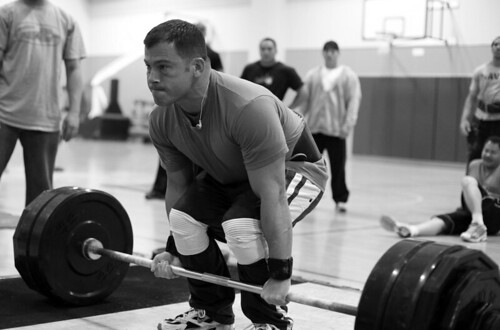
Therefore, in order to get bigger, stronger muscles the same stimulus is needed. That stimulus is short, intense training sessions. Why short? Because we have known for centuries the body can either train long or train hard. A perfect example is to compare distance runners to sprinters. Because of the types of training, one is emaciated looking and one is muscular. Remember you can not sprint a mile. Is it difficult to run a mile, yes? But it is essentially impossible to run a mile with 100% intensity.

The other factor one needs to take into consideration for building bigger, stronger muscles is recovery. How much or how often can you train? Or better yet, how much “should” you train? Here is where the differences in genetics lie. Our muscles need the exact same stimulus in order to cause a chain of events that forces them to adapt by making bigger stronger muscles. However, the rate at which we are able to recover from these intense bouts is as different as the shapes and sizes of our bodies.

So what are you to do? If you’re training using the typical muscle building routine, which is 3 or more working sets per exercise and 4 or more sessions a week, and not getting anywhere, change it. First, reduce your sets per exercise by half and only train each body part once a week. If you still don’t make gains or you plateau after a short while, reduce your sets again. Remember, if you’re training with 100% intensity and you’re not making gains, you’re not recovering.

More is only better when it comes to sex and money.

More is only better when it comes to sex and money

The duration of exercise is the volume or number of sets performed. Intensity and duration have an inverse relationship. Meaning, the harder you train, the less time can be spent training. This is because we have a finite amount of fuel available to carry that level of stress. This is not a choice or an opinion; it?s fact.

Let?s take another look at a sprinter versus a marathoner. By definition a sprint is: To move rapidly or at top speed for a brief period, as in running. The key words here are ?top speed? and ?brief?. A sprinter runs with all out effort or 100% intensity. Because of this all out effort, which is a tremendous amount of stress on the body, the duration of the movement is brief. Now it becomes clear why a 400 meter run and longer are not considered sprints. Although some do consider the 400m a sprint, runners are not running with all out 100% effort as in the 100m or 200m sprints. Point being, one can only exert themselves with 100% effort for so long.

In the case of marathon runners, they train at a very low intensity. Because of the inverse relationship between intensity and duration, unlike sprinters, endurance athletes can train for extended periods of time. This is not to say endurance training is not difficult, I am merely pointing out the physiological fact the body can only train so hard for so long.

This brings us to the second way most people train too much, but the most common; too many sets. Although training hard is the best way to move forward, some people are under the impression that doing more is training harder. This couldn?t be farther from the truth.

Training all out, poses extreme demands on the body’s resources, which are governed by genetics and in limited supply. Because of this finite supply, the body will not allow you to train ?too hard? for too long, and gives clues you are reaching your limits. Once you reach failure performing a set, or run out of gas during a workout, you?re simply not able to train any harder. It doesn?t matter what you do at this point, the body is done. Performing anything more than what is optimum, will hinder your progress. Yet, at this point, most perform more sets with reduced weight or reduced intensity because of the more is better mentality. Do not get caught in this no win cycle.

The most underated component of training programs, recovery

We all recover from exercise at different rates. Many people who recover quickly have reached a high level of success performing a high number of sets. Many who recover slowly have also been very successful performing low numbers of sets. Because everybody is unique in their ability to adapt and recover from different programs, the number of sets needs to be individualized.

A very important component of a training program that should be given consideration is training frequency. How often can, or more importantly, should I train per week? Optimum recovery time between training sessions is essential if one is going to continue to make progress. Training frequency, which is determined by ones recovery ability, is often a forgotten part of most training protocols.

Don’t be so concerned with how many training sessions you can handle per week. Be more concerned about the optimal amount. More is not always better. In fact, when somebody comes to me for advice because they’ve stopped making progress, usually I either reduce the workout volume or add days off. There is no reason to go to the gym if you’re not going to make progress.

Does it make sense to keep doing the same routine if gains are not being made? Isn’t the definition of “crazy”, doing the same thing over and over expecting different results. If your current program is not working, change it. The number one complaint people have is they’re not making progress or their progress has come to a halt. In both cases, the answer is more recovery time. Understanding the fact our bodies have a finite amount of recovery ability should help explain this concept.

The following is Mike Mentzer’s explanation of overtraining and recovery. I’m sure you’ll find it interesting.

In bodybuilding, the idea is to impose a training stress onto the body that will serve to induce the biochemical changes which result in muscular hypertrophy. Applying any more of the training stress (high-intensity) than is required by nature will result in the equivalent of over-dosing on a medicine; or, as we say typically in bodybuilding – overtraining.
A person exposed to the sun’s ultraviolet rays at the equator in summer would not have the slightest concern whether the intensity of the sunlight stress is high enough to disturb the physiology sufficiently to induce an adaptive response, i.e., the buildup of a suntan. His only concern, his overriding consideration, would be to properly regulate the volume (or duration) and frequency of exposure time so as not to overdose on the stress/stimulus; and, thereby, incur a sunburn or, in extreme cases, death. A person seeking to develop a suntan at the equator, or wherever the intensity of the sunlight is high has no concern that he will develop a suntan; but only if he doesn’t overexpose. (Note that bodybuilding science is largely based on the medical discipline of stress physiology. Also, that the end result of the healing of a sunburn is not a suntan, just as the end result of the healing of overtraining is not greater strength or added muscle.)
As the stresses grow progressively greater, they will eventually reach a critical point such that they constitute overtraining. The first symptom will be a slow down in progress; and if the individual continues with the same volume and frequency protocol, the stresses will continue to increase until there is a complete cessation of progress, typically referred to as a “sticking point.” One need not ever experience a slow down in progress, let alone a sticking point, if he bears in mind all the while that as the weights grow progressively greater so do the stresses; and he must do certain specific things to compensate for them.

MikeMentzer.com

Training Frequency

How often can, or more importantly, should I train per week? Optimum recovery time between training sessions is essential if one is going to continue to make progress. Training frequency, which is determined by ones recovery ability, is often a forgotten part of most training protocols. It never ceases to amaze me how many people train for months and years experiencing little or no success, and never consider the fact they may be doing too much.

Don’t be so concerned with how many training sessions you can handle per week. Be more concerned about the optimal amount. More is not always better. In fact, when somebody comes to me for advice because they’ve stopped making progress, usually I either reduce the workout volume or add days off. There is no reason in going to the gym if you’re not going to make progress. In every workout, if you have fully recovered, and you come ready to work, you should make progress, which is gauged by your strength.

How can anyone get stronger every workout? One can only bench press so much. Eventually, you have to hit a plateau. This is true. If one stays with the same exercises, the same number of reps and the same number of sets, progress may eventually stop. If the proper changes aren’t made at the right time, eventually the body adapts to the stimulus. And this is where the “art” of program design comes to play.

It’s easy to follow a workout. The real challenge is assuring the stimulus is sufficient and more importantly, you recovery from workout to workout so that progress continues over a long period of time. Sometimes this entails having the discipline to deviate from something that is not working. If you’re not making progrss, and you’re training with all out intensity, try taking an extra day off.

Lose weight faster by doing cardio between sets

Men?s Fitness.com has three tips to how you can shed pounds in a quicker amount of time:

1.) TRY CARDIO BETWEEN SETS
Go about your weight workout as normal but instead of resting between sets, perform light cardio such as jumping rope, doing jumping jacks, or hitting a heavy bag for between 60 and 90 seconds.

2.) ALTERNATE INTERVALS
Perform a set and then do some highly intense activity for 15 seconds, followed by a 45-second easy bout for recovery. Then go back to the weights for another set. You can pair your lifting with any kind of cardio ? a treadmill sprint, intervals on an exercise bike, or with a jump rope, etc.

3.) TRY A CIRCUIT
Start with compound movements, followed by isolation lifts. For instance, do a squat, followed by a lunge, hamstring curl, and leg extension. Do not rest until after the last exercise and then rest two to three minutes. You’ll get an awesome pump while burning lots of calories.

To read the entire article, click here.

The most important thing to remember is that your diet must be sound. You can run 100 stairs in between every set on the bench, but if all you?re consuming outside of the gym is fatty, processesed foods, you?re not going to drop the weight.

That said, the article does highlight a couple of nice techniques to try if you?re getting tired of your current routine and can?t seem to lose that stubborn weight. I would warn, however, that if you?re trying to pack on size, continuously doing cardio between sets will zap your strength and therefore gaining muscle will be a challenge. For hard-gainers, resting between sets is the better way to go if you?re trying to bulk up.

« Older posts Newer posts »