 What is CrossFit (CF)?? In a nut shell it?s performing movements and or exercises under time that are continuously varied from workout to workout.? Started in the mid 1990?s, this training system does have value in improving ones fitness level; that?s where the benefits stop.
CF?s upside according to its proponents is being a total-body conditioning workout that is purposefully varied, which inhibits boredom.? I think it?s a home run for fitness enthusiasts because the workouts are challenging and competitive.? CF?s inherent difficulty, notice I said difficulty not intensity, also benefits the average person because most people do not train hard enough to elicit any measurable result.
The seemingly illogical CF programming is an effort to challenge as many movement patterns and energy systems as possible.? ?CF is not a specialized fitness program but a deliberate attempt to optimize physical competence in each of the ten recognized fitness domains.? They are cardiovascular and respiratory endurance, stamina, flexibility, power, speed, coordination, agility, balance and accuracy.? Says founder Greg Glassman who is also known for his outrageous unsubstantiated claims about the benefits of CF.
 Its the lack of specificity that gives CF it?s upside and its downside. Because the body is receiving multiple forms of stimulus the body never excels at any of them.? Somebody who starts out as a crossfitter and was not strong or muscular through previous training, will not make appreciable gains in strength or muscularity.? Sure, one can get very fit, but that’s too one dimensional.
Intensity and duration exist in an inverse ratio. In other words, as the intensity while performing an exercise increases, the amount of time one can perform the exercise decreases.? CF proponents claim their program utilizes a high level of intensity.? Well, there is no such thing as performing a movement or exercise for 5, 10, or 30 minutes and training with high intensity.? This is a physiological fact, not a choice, and certainly not something you can ?build? up to.
Is CF difficult? You bet your ass.? Is CF Intense? No.? This can best be explained by comparing a sprinter and a miler.? Any type of endurance event is by its very nature of low intensity.? Sprinters are always sucking wind at the end of a race.? In contrast, long distance runners are usually breathing close to normal after several miles of running.? It doesn?t matter how long a world class sprinter trains, because he is going all out physiologically, he is breathing hard every race.? Sprinters, as a result of their intense training are far more muscular than the thin distance runners.? This is not to say distance runners don?t work hard, they do, but the body can only perform at a high level of intensity for so long.? And intensity is a prerequisite to gaining strength and muscle.
You?ll never get truly strong performing CrossFit. No matter what Glassman or other CF coaches claim, it?s not going to happen.? A CrossFitter will never be able to achieve strength gains anywhere near the level of a powerlifter or even a strength enthusiast.? The vast majority of crossfitters have no appreciable strength what-so-ever.? The CrossFitters who are fairly strong or muscular, are former bodybuilders, powerlifters and weight lifting enthusiasts.? Training that targets endurance strength doesn’t increase maximal strength.? Training for maximal strength, however, does increase one’s strength endurance. ? If getting stronger, especially maximal strength, is your goal CF isn?t for you.
 You will not attain any measure of lean mass. CF?s founder Greg Glassman claims CF, for the natural athlete, is better at building muscle than traditional hypertrophy weight training.? As with most of his claims there?s no science or empirical data to back this assertion.? While touting the muscle building capacity of CF he fails to explain, the lack of muscularity among most CF athletes.? Crossfitters don?t come close to the muscular development of a natural bodybuilder.?? At best some Crossfitters look athletic, which is great, if that?s your goal.? But, if you want to be muscular, CF is not for you especially if you?re a hard gainer.
It?s been well documented that within the fitness industry for decades that brief high intensity muscular contraction is the most important stimulus for building muscle and strength.? The duration of the exercise or movement is crucial, but can be counter-productive.? Sets lasting 5, 10, 30 minutes are completely of target for building anything but endurance.
If overall conditioning is what you want?? If improving your physique is what you want?? If increasing your endurance is what you want?? Learn how to train each energy system properly for optimum results.? CrossFit needs to be taken for what it really is, a great fitness program.? That?s where it ends.
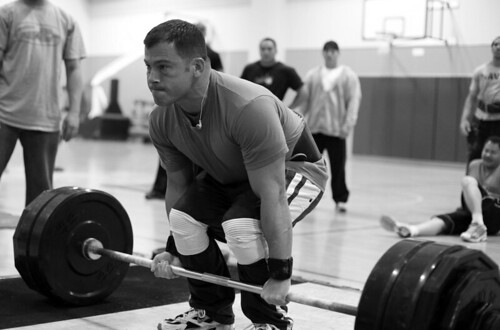 Therefore, in order to get bigger, stronger muscles the same stimulus is needed. That stimulus is short, intense training sessions. Why short? Because we have known for centuries the body can either train long or train hard. A perfect example is to compare distance runners to sprinters. Because of the types of training, one is emaciated looking and one is muscular. Remember you can not sprint a mile. Is it difficult to run a mile, yes? But it is essentially impossible to run a mile with 100% intensity.


