Category: Specific workouts (Page 5 of 14)

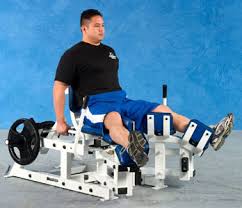
Abductor and Adductor machines

Purpose:? These machines are designed to isolate the muscles that spread the legs apart and bring them together.

Pros:? The machines allow you to feel the burn in the targeted areas.

Cons:? Despite the perception (mostly among womem) that these machines “tone” flabby thighs, they don’t actually apply enough resistance to burn many calories.? Because they don’t allow the legs to stabilize a load like squats or lunges, the abductor and adductor don’t build much strength or muscle.? Plus opening and closing your legs in a public gym is just asking for trouble.

Verdict:? Bad.? “If you want strong, athletic looking legs,” says Jason Ferruggia, an MF training advisor, “you need to squat, lunges and deadlift.”? Those simple movements will train the thighs’ inner and outer areas much more efficiently and without comprimising your manhood.

Men’s Fitness March 2008
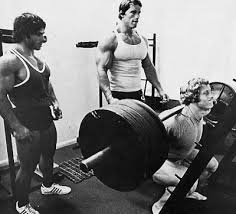

Amazingly these machines are still in many fitness centers and gyms. It isn’t bad enough that women are still using these contraptions, but amazingly I also see men using these useless machines. Why? outside of shear laziness and ignorance, I haven’t a clue. The adductors and abductors are worked to a much higher degree by performing multi-joint lower leg exercises like the squat and it’s variations.

There is no such thing as a free lunch. Working legs properly, like anything that yields good results, takes effort. If you can talk while you’re performing a set, go home. Start taking your sets to the point at which you start breathing hard and feeling a deep burn in order to get the gains you want

Time equals muscle

A highly overlooked, but very useful tool for progressive resistance training is – Tempo. I will even go one step further and call tempo an essential tool for attaining optimum results from weight training. Yes, it’s true one can attain results performing reps just like every other hack in the gym, but I’m talking about optimum results.

If you’re going to spend the time in the gym, why not get the most out of it. The biggest reason most people who weight train don’t use tools like tempo is shear laziness. Performing a set to momentary failure, to the point where you can’t possibly get another rep is grueling. Few people have what it takes to train correctly, achieving 100% intensity. Hence, the legions of frustrated people in gyms across the US. Like any endeavor, doing your best takes hard work, focus and dedication.

So what is tempo? Tempo goes hand in hand with “time under tension” or TUT. TUT is simply the amount of time a muscle in under tension. To develop the optimum amount of muscle in the shortest amount of time, a set should last between 20 and 60 seconds.

Tempo is the speed of your reps. It is expressed and recorded by three or four digit numbers representing the seconds required to complete a rep. Example: 402 (four, zero, two) or 50X0 (five, zero, explosive, zero). Using the bench press, the first digit is the speed in which the weight is lowered (negative). The second digit is the amount of time one pauses once they’ve reached their chest. The third digit is the amount of time one takes to raise the weight (positive). The forth digit, if used, is the amount of time one takes before lowering the weight again. If an “X” is used, it means explosive, or as fast as possible.

Designing Your Workouts

Is it really necessary to count each rep in order to build strength and muscle? No. Is it necessary to lift under control and to vary your speeds to get the best most rapid gains per your genetics? Yes. When you perform an exercise under control, the muscles are truly doing the work. ?Slower?, not ?slow? speeds make the muscles work harder by eliminating momentum and bouncing. There?s nothing impressive about performing a bench press by allowing the weight to drop, bounce off your chest and then barely being able to complete the lift.

If tempo is used properly, the target muscle group is truly performing the exercise. Tempo forces one to lift in a very controlled manner, but like any training tool it should be used as an adjunct to your weight training program.

The Good Morning

Bending over to pick something up can be a very dangerous move if done with a rounded back. Most people in their lifetime will have an injury to the lower back. One way to help prevent such injuries is to do the good morning.

Performing the good morning is an excellent choice for strengthening and building the posterior chain, which includes the lower back, glutes and hamstrings. The glutes (butt) and the hamstrings are responsible for hip extension while the muscles of the lower back (erector spinea) are contracted statically.

Because of the large degree of hip flexion, the gluteus maximus and the hamstrings are utilized throughout the movement. The glutes work in unison with the hamstring to extend the hips in the concentric (raising) part of the movement. The hamstrings, located on the back of the upper thigh, become more involved as you begin to decrease the degree of hip flexion while raising the weight. The erector spinea, which run the length of your spine on both sides, are statically contracted throughout most of the movement, keeping the normal curvature of the spine. A static contraction of the rhomboids and the trapezius muscles help maintain the shoulders.

Extension of the body occurs when the upper body, torso and pelvis rotate up and back. The biggest mistake I see with this movement is allowing the back to ?round? and magnifying the kyphotic (upper back) curvature while de-emphasizing the lordotic (lower back) curvature. I need to add that a slight curve of the upper back will present no danger and will happen to most while using heavy weight, but if you look like a big question mark (?) while performing the exercise, that?s a different story.

The good morning

Perfect Pecs

Like a great set of developed arms, a well developed chest always gets attention.? Chest and arms are the most frequently worked body parts in any gym across the country.? You never hear of anyone skipping a chest workout to do legs, but frequently hear people skipping their leg workout.? Most of this is due to shear laziness, but some is because chest is much more fun to work.

In their quest for an “Arnold like” chest many people look for that one exercise or that one workout that, like magic, will give them the chest they want.? Unfortunately, genetics, as with all body parts, determines the size and shape of ones chest.? This doesn’t mean, however, that one can’t improve upon what they have.

Do not get caught up in the game of trying to make your muscles look a certain way.? You will consistently be disappointed.? Instead concentrate on making the best of what you’ve got.? You can do this by hitting the chest from a variety of angles.? It is also imperative you “feel” the muscle being worked.? Concentrating on feeling your chest work is as important as performing the exercises. And last, using TEMPO to increase muscle tension is essential and will help to improve your concentration level.?

Learn more about these and other guidelines to build Perfect Pecs.

Fitness Myths Busted

Is performing cardio the best way to lose fat?
There are 3 things to keep in mind about cardio when trying to get leaner. One is that it doesn?t build muscle. Two, it doesn?t preserve muscle while losing weight. Both are extremely important if your goal is not only to get leaner, but to stay that way. As we lose weight the body does not discriminate where the weight comes from. We lose muscle along with fat, especially on a low calorie diet. And performing cardio accentuates this phenomenon.

Lastly, unless you enjoy cardiovascular training, it?s just not worth the time. The work to benefit ratio is dismal to say the least. Unless you?re willing to bust your butt and perform 60 ? 90 minutes of cardio a day, which will hinder your muscle building capacity, cardio is not worth it.

Will training your abs using the right exercise our equipment give you washboard abs?

Is reducing your calories the best way to lose weight?

If I’m not sore a couple of days after a workout, did I not train hard enough?

Get the answers to these and other common fitness myths in my Fitness Myths Busters article.

« Older posts Newer posts »