Category: Sports Health and Fitness (Page 3 of 8)

Squat and dead lift vs stability ball exercises for core activation

Unstable Surface Training (UST) has moved from being used almost exclusively in rehabilitation to becoming common place among personal trainers and strength coaches. One can’t go to a gym and not see somebody training on a Bosu ball, stability ball, wobble board or foam pad. It’s so popular entire books have been written on this type of training. But do not be fooled by its popularity.

UST is not popular because it works, but because of a tremendous media campaign. The fitness industry is always looking for something new. They know here’s huge money in marketing a piece of equipment and/or workout program.

Performing exercises on unstable equipment can be challenging no doubt, but research has not shown that the type of balance, and core stability developed through UST will transfer to any sports skill. Performing exercises on unstable equipment will make an individual proficient at performing resistance exercises on unstable surfaces but will not improve sports performance. Is UST training even necessary?

Researchers from Appalachian State University compared trunk muscle activity during stability ball and free weight exercises. The stability ball exercises utilized were the quadruped, pelvic thrust and ball back extensions. The free weight exercises were the squat (SQ) and deadlift (DL). During all exercises muscle activity was collected using electromyography (EMG).

During the study trunk muscle activity during SQ and DL’s was equal to or greater than which was produced during stability ball exercises. This was true even when 50% of the 1 rep max was used during SQ and DL. The role of UST is again shown to be in question.
(Journal of Strength Conditioning Research 22:95-101,2008)

Titanic triceps

Most people who workout love training their arms; rarely do you here of somebody skipping their arm workout. You never see somebody walking around with large muscular legs and skinny arms. In fact, it’s just the opposite. This is in no small part due to the fact that no other body part exemplifies strength and development, and is the envy of others like a muscular pair of arms. In the following article I walk you through one way to properly bang your your triceps to new growth.

All too often, a personal trainer or instructor will isolate a particular muscle so much that it becomes detrimental to the workout. You may be asking, “How can you isolate a muscle too much? Isn’t that what all the magazines say to do?” Yes, that is what a lot of magazines tell you to do, and I agree it’s good to isolate the muscle being worked. I’ll even go one step further and say that it is not only good but also absolutely necessary for optimum muscular growth. However, many instructors and fitness enthusiasts are so concerned with isolation exercises that they’re neglecting form and function.

How does form and function relate to triceps training? Let’s look at what the triceps actually do. The triceps extend, or straighten, the arm. For example, without your triceps it would be virtually impossible to grab a beer from the fridge. That would truly be a tragedy. Without triceps, your arm would be in a constant flexed state. This having been said, exercises that stress movement only at the elbow (such as triceps pressdowns) are solid movements. However, I am starting to see less and less multi-joint movements used in workouts. Examples of multi-joint movements for the triceps would be close grip bench presses, dips and a few others. These exercises involve not only the elbow joint but the shoulder joint as well.

9 Weeks to Bigger Arms

Stretching, why?

Despite the years of research and mountains of data, there still is no definitive answer to whether stretching is worth your time and effort. Proponents argue that stretching prevents injury, diminishes delayed onset muscle soreness and improves athletic performance. Some go as far as to say that regular stretching can help speed recovery from workouts and improve blood flow to the area being stretched. Opponents will argue that stretching can actually cause injury, and does nothing to improve performance or prevent delayed onset muscle soreness. In fact there are many experts who not only believe stretching does nothing to improve performance, but that it can significantly hinder it. Each side can site numerous studies to support their claims.

Because there is so much conflicting data, should we even bother stretching? The answer is a resounding “yes”. Especially if you lack normal range of motion in your joints. Our bodies are a feat of engineering that man, in all his wisdom and brilliance, cannot replicate. For example, as we grow and develop into adults, we are provided with a certain degree of flexibility governed by our genetics. This flexibility allows us to have a normal range of movement around a joint. This range of movement is crucial to the health of our joints. Training, injuries and the natural aging process all will diminish flexibility and the range of movement we started with. Flexibility is not only lost or gained in the muscle, it’s also determined by tendons, ligaments and other connective tissue. It is this relationship between bones, muscles, tendons, ligaments, etc., that took millions of years to perfect through evolution. Any disturbance between the structures in our joints can lead to hindered performance or serious injury.

No matter which side you take, and no matter what the reason, the data is conclusive on one point: It’s much more effective to stretch muscles that are already warmed up. A warm-up is light to moderate activity lasting 10 – 15 minutes before the actual workout begins. Warming up drives blood into the muscles and synovial fluid into the joints, thus reducing stiffness. If you warm-up first, you’ll make much more progress than if you stretch cold.

To evaluate whether you are developing a restriction around a joint, and to see a list of stretches in their proper order go HERE.

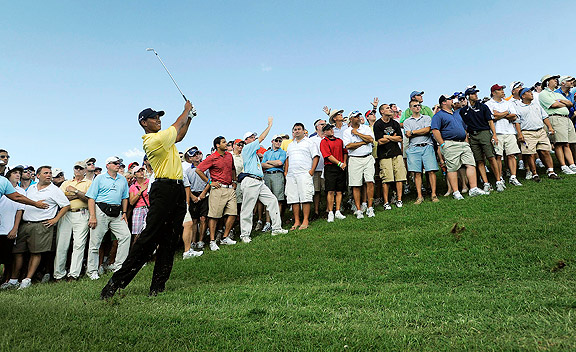
Improve your golf game with these exercises

The New York Sports Clubs shares some tips to get your body in golf shape for when you attack the links this summer.

Big Bertha ? Driving power from your legs and arms will increase your yards. Grab your driving club and get started:

Stand with feet a little wider than shoulder width. Bending at the hips and knees, lower into a squat and hold the position. Hold the club with both hands in front of you, parallel to the floor. While holding the squat, bend the elbows bringing the club to the chest at an angle, press out and repeat with the angle in the other direction. Continue pressing in and out at a diagonal for 30 times, working your way up to 75.

Caddy Shack ? For stamina to walk the course, follow this move to get your heart rate up and cardiovascular system conditioned:

Place three tees on the floor about two feet from each other in a line. Starting on the left of the first one, hop over each with a dbl hop between them. When you get to the end, hop back to the starting position. Try to continue hopping for 30 seconds, working your way up to a minute.

Hole in One ? Core strength is imperative to drive the ball down the green. Try this core strengthener to get that hole in one:

Sitting on the floor with your feet flat on the ground, grab a golf ball in your right hand. Lean back slightly, lifting your feet off the floor a few inches holding yourself stable by contracting your stomach muscles. Holding that position, gently lower right leg as you slightly lift the left and pass the ball through the legs to the left hand. Switch the legs and pass the ball back to the right hand, through the legs. Continue for 20-30 repetitions.

Back Nine ? With all the swinging and bending, a golfers low back is a must to strengthen

Lie on your stomach, legs out straight and arms straight at your side. Lift up your head and legs at the same time, keeping your spine in line with your head. Hold the position with your low back and glutes for 3-5 seconds and release. Start with 8-10 working your way up to 15.

Club House ? When your game is over, before hitting the showers or clubhouse, make sure to stretch

On all fours, round your back so you feel your spine open, lifting up your belly button to the ceiling, tucking your glutes and head under. Hold for 3 seconds. Reverse the move by lifting your head to the ceiling and curving your back under, tail bone to the ceiling.

There you have it. If your game still stinks, then it might be time to pick up another hobby!

Lose weight faster by doing cardio between sets

Men?s Fitness.com has three tips to how you can shed pounds in a quicker amount of time:

1.) TRY CARDIO BETWEEN SETS
Go about your weight workout as normal but instead of resting between sets, perform light cardio such as jumping rope, doing jumping jacks, or hitting a heavy bag for between 60 and 90 seconds.

2.) ALTERNATE INTERVALS
Perform a set and then do some highly intense activity for 15 seconds, followed by a 45-second easy bout for recovery. Then go back to the weights for another set. You can pair your lifting with any kind of cardio ? a treadmill sprint, intervals on an exercise bike, or with a jump rope, etc.

3.) TRY A CIRCUIT
Start with compound movements, followed by isolation lifts. For instance, do a squat, followed by a lunge, hamstring curl, and leg extension. Do not rest until after the last exercise and then rest two to three minutes. You’ll get an awesome pump while burning lots of calories.

To read the entire article, click here.

The most important thing to remember is that your diet must be sound. You can run 100 stairs in between every set on the bench, but if all you?re consuming outside of the gym is fatty, processesed foods, you?re not going to drop the weight.

That said, the article does highlight a couple of nice techniques to try if you?re getting tired of your current routine and can?t seem to lose that stubborn weight. I would warn, however, that if you?re trying to pack on size, continuously doing cardio between sets will zap your strength and therefore gaining muscle will be a challenge. For hard-gainers, resting between sets is the better way to go if you?re trying to bulk up.

« Older posts Newer posts »