 If you are approaching 40 years of age or beyond, you are probably starting to realize you can no longer train like you did in your twenties.? I learned this lesson the hard way.? At 36, I tore both quadriceps in seven places.? Thank God?the MRI revealed they were mainly fascia tears not requiring surgery.? None-the-less, I had to walk with crutches for a week. 18 weeks later, I tore my right hamstring.? At 38, I had to have my triceps reattached.? At 39, I partially (20%-25%) tore my right pec, but opted not to get surgery.
After that last injury I finally threw in the towel.? I thought my days of pushing my body with high intensity workouts were over.? Although, all the areas had been injured in previous years, I still trained in fear because none of these injuries had any preceding symptoms.? Consequently, my training?took on?a very slow tempo?with insufficient loads.??This type of training left me?feeling like shit, physically and mentally.? Why train at all if I can’t train hard.? Instead of training smart and doing what I should do for my body, I was too concerned with how I wanted to train.?
Almost to the day, a year after I tore my pec, I was so frustrated with my lack of progress, I decided something had to give.? I ended up going back to the basics.? I came to the realization I had to train myself as I would any other client.? I had to concern myself with what my body could and needed to do.???
The first thing I did was give up exercises that caused me pain no matter how much I loved performing them.? One of these, unfortunately, was the barbell squat.? With 3 bulging disks it’s not worth the pain or the risk.?? The second change I made was incorporating more functional exercises into my workouts.? These mainly included unilateral exercises and a few stability exercises.?
Perhaps the biggest change I’ve made is the way I approached my work sets.? Since I am no longer competing, there is no need for me to walk that tight rope between training with 100% intensity and injury.? Don’t get me wrong, I still perform my sets to failure, but will not train through pain.? I also stopped doing any kind of cheating at the end of my set to push the limits.
In order to make gains one has to pushing the limits, but it has?to be wrangled in.? For this to happen, the goals you set that govern drive must be adjusted to your current capabilities.? I have reached a point where I take my time with my goals by practicing wisdom not ego.? Through training smarter, I found a renewed vigor and enjoyment I had 20 years ago.

 Every year the NFL invites about 3% of approximately 10,000 college football players to participate in a series of tests called a combine. A combine is designed to assess the skills of promising college football players. These athletes give it their all in hopes of getting drafted and consequently being offered a contract. Although the tests used during the 5 days of the combine require skill and athleticism, its predictive value is in question.
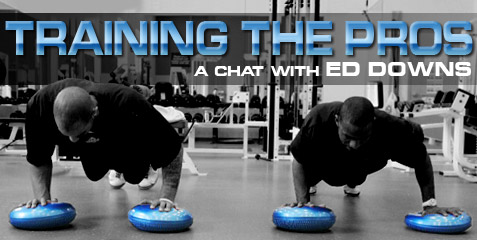 Ed developed the patented Downs Disc Fitness System, a training and exercise system. It is used and endorsed by professional athletes, the University of Miami basketball team, high schools around the country, rehab centers, pregnant women, and thousands of people with weight, type 2 diabetes and respiratory problems. Without corporate funding, Ed realizing his dream through self-financing (by asking clients to pay him in advance), taking out a second mortgage and the sweat equity of 14-hour days.