Category: Exercise (Page 11 of 34)

Racquetball for Weight Loss

Any type of exercise is good exercise, but some forms of exercise are better for greater weight loss than others. Group sports, and other types of exercise that work the body from head to toe, burn hundreds of calories per hour and they also challenge all muscle groups. Not only can this help you lose more weight, it can also help you keep it off. Just a few uber effective forms of exercise are swimming, cardio boot camp, running, basketball, and racquetball.

Racquetball is similar to handball. The game is played on a four walled court with a short-handled racket and a larger ball. The game is usually played by two players, but four players is also common. The amount of calories burned during an hour long game varies by weight and whether or not the game is casual or competitive. To give you an idea of just how many calories you can burn, a person that weighs 125 pounds can burn around 400 calories during a casual game or 568 calories during a competitive game. A 170-pound person can burn 541 calories during a casual game or 773 during a competitive game.

Racquetball can help you lose weight if you make smart food choices and commit to playing at least three times a week. Once you lose the weight, if you want to keep it off, stick to a sensible diet and try play on most days of the week.

So where are the Racquetball Courts?

If you’re looking for a place to play racquetball, look no further than your local health club, tennis club, community center or park district. If you’re looking for the cheapest place to play, try a community center or park district where public courts are typically no more than $10 an hour.
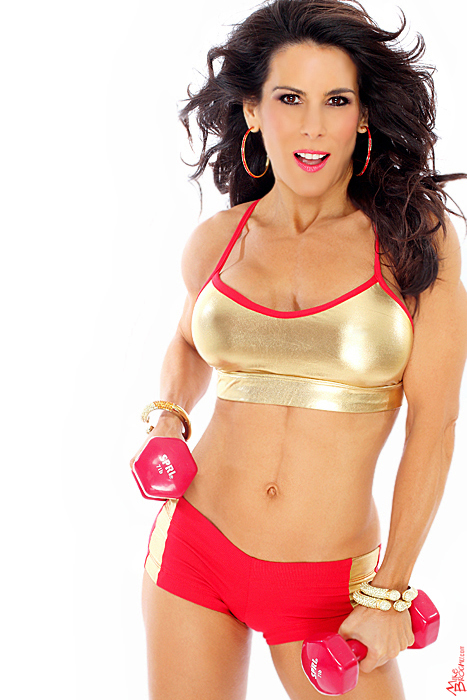
Weight Loss Transformation of Fabulous Fit Mother

Laura London burst onto the fitness scene a little more than a year ago and has been on fire ever since. This spicy and super sexy 5’ 2” 45 year old wife of 20 years and mother of three shows us that age has no barrier on fitness. What Laura has accomplished in the past year is just short of amazing. Check out her story below and check out her Facebook page with her amazing photos!

Laura went from an out of shape, stay at home mom to a national level figure competitor, internationally published fitness model, has been cast in infomercials, movie trailers and exercise DVD’s. She has started her own fitness web site and was also voted “2010 Over 40 Transformation of the Year” by BodyBuilding.com and that is just the beginning for this highly driven fitness role model, wife and mother.

We managed to book her for a rare and exclusive interview to find out all her secrets and tips on getting ripped, staying young forever and having amazing six pack abs in the fitness industry. Not only has Laura transformed her life, but now she is helping millions of other moms do the same.

Laura wasn’t always in shape, and actually working out and even being physically fit was extremely shunned. Growing up Laura was not even allowed to play sports, because of the rare condition her brother suffered from. He is a hemophiliac so sports were something that was not done in her family. She had to learn from scratch what is was like living a physically active and fit lifestyle after becoming a mom of three in her late thirties. It was not until her mid thirties and three kids later that she decided to take charge of her life and the direction of her health.

Laura lost over 20 lbs all by making simple yet powerful lifestyle changes, such as making the time to exercise, setting goals and staying motivated. Her new found fitness fire propelled Laura to become a nationally certified personal trainer with the NSCA, the only personal training certification to be accredited by the National Commission for Certifying Agencies. She is also one of the first Master Certified JNL Fusion trainers in the world. But that was not the end, she went on to become an award winning national level figure competitor and fitness icon. Laura is a fitness role model for women in there 40’s, showing that with passion and determination there are no excuses. You can “Exercise Your Right to be Sexy” at any age.

Read the full article.

The optimum time to train

there are many biological factors that are important for muscular hypertrophy like hormone levels, age, sex, muscle fiber type, diet, among others. These factors have been recognized as extremely important for the hypertrophic adaption to strength training. Many of these factors, however, are known to vary throughout the day. Can the daily differences in the above factors like hormone levels, affect the adaptive response to strength training? What time of day is the best time to train?

A study published in the Journal of Strength and Conditioning Research set out to examine the effects of time-of-day-specific strength training on muscle hypertrophy maximal strength in men. The training group underwent a 10 week preparatory training regimen. Afterwards, the subjects were randomized to either a morning training group or an afternoon training group. The groups trained for another 10 weeks with training times between 07:00 and 09:00 hours and 17:00 and 19:00 hours in the morning group and the afternoon group respectively. Cross-sectional areas and volume of the quadriceps femoris were obtained by magnetic resonance imaging at weeks 0, 10, and 20. Maximum voluntary isometric strength during unilateral knee extensions and the half squat one repetition maximum were tested at weeks 0, 10, and 20.

The entire 20-week training period resulted in significant increases in maximum voluntary contraction and 1RM in both training groups. In this study, the magnitude of muscular hypertrophy and strength did not statistically differ between the morning or afternoon group. However, this study was of short duration and like most research concerning physical improvement through exercise, there needs to be more subjects over longer periods of time.
(J Strength Cond Res 23(9):2451-2457)

Buying New Gym Shoes? Let Your Feet Lead the Way!

Some like them light, others like them heavy and some like them somewhere in between. No matter what you prefer, there’s a gym shoe out there just waiting for you, all you have to do is walk into the athletic store and let your feet do the rest. Just in case you’re unsure about what your feet (and your body) need to be comfortable, here’s what you should look for:

A specific shoe for a specific activity.
It’s never a good idea to purchase a pair of gym shoes that are made for walking if you’re planning to run. Walking shoes tend to be stiff, while running shoes are flexible with extra components such as cushioning to handle higher levels of impact. Running in walking shoes can lead to aching heels, shin splints, and muscle aches.

Shoes that fit your foot type and no one else’s.
Some us have flat feet, others have narrow feet, and some of us have wide feet. Never try to stuff your wide feet into a narrow pair of gym shoes because they look good. You’ll end up with more than just aching heels at the end of the day. A good shoe store will have all the equipment it needs to measure your foot precisely, and match you with the perfect shoe. Listen to the salesperson’s suggestions and you won’t be sorry later. Here’s another tip, foot size continues to change as we age, so have your feet measured twice a year.

Wiggle room.
Ok, so of course you need extra room for socks, but you’ll need even more room to wiggle your toes. Yes, gym shoes should not be snug at the front, but your heel shouldn’t slip out of the shoes either. Leave at least 3/8-1/2 inch between the front of your big toe and the inside of the front of the shoe for a comfortable fit. You shouldn’t feel any tightness anywhere. If you do, keep trying until you don’t!

Cutting-edge components for whatever ails you.
Having trouble getting shoes to fit no matter what you do? Try a pair that allows you to pump up the tongue for a customized fit. Got heel pain? Try a pair of gym shoes that come with clear inserts or shoes that are filled with gel, air, or Freon. These components add extra shock absorption, so you’re feet are less likely to hurt after a vigorous workout.

Mileage.
Yes, shoes rack up the miles, just like a car. And, like a car, they can break down when they’ve racked up too many. Ask the salesperson how many miles your shoes will last. The figure should be somewhere between 350 and 400 miles. Once your gym shoes hit the mark, it’s time to trade them in for a new pair. If you just don’t have time to calculate miles, it’s ok. You can go by how your shoes look and feel. If the shoes no longer offer support, they’re uncomfortable, or the back heel is worn out, it’s time to throw those puppies out and buy a new pair.

For more information about choosing the best gym shoes for your feet, visit WebMD.com.

Easing the symptoms of arthritis

46 million adults have been diagnosed with arthritis. 9% of these individuals claim arthritis limits their physical capabilities; 21 million people alone suffer from osteoarthritis. Unfortunately, the incidence of arthritis is on the rise, but there are things you can do to ease the symptoms.

Exercise can be a great way to deal with the aches and pains of arthritis. But it’s important to perform the right exercises under a doctor’s supervision.

Here are suggestions about exercising if you have arthritis, courtesy of the University of Washington School of Medicine:

  • If you have a physical or occupational therapist, he or she should participate in creating your exercise plan.
  • Your exercises should put minimal stress on your joints, especially when you first start out. Don’t overdo it.
  • Try a combination of both therapeutic (designed to help ease symptoms and improve joint function) and recreational (just for fun) exercises.
  • Use other methods to ease symptoms, such as using heating pads and ice packs, eating a healthy diet, taking medication as prescribed, and maintaining a healthy body weight.

(HealthDay News)

« Older posts Newer posts »